

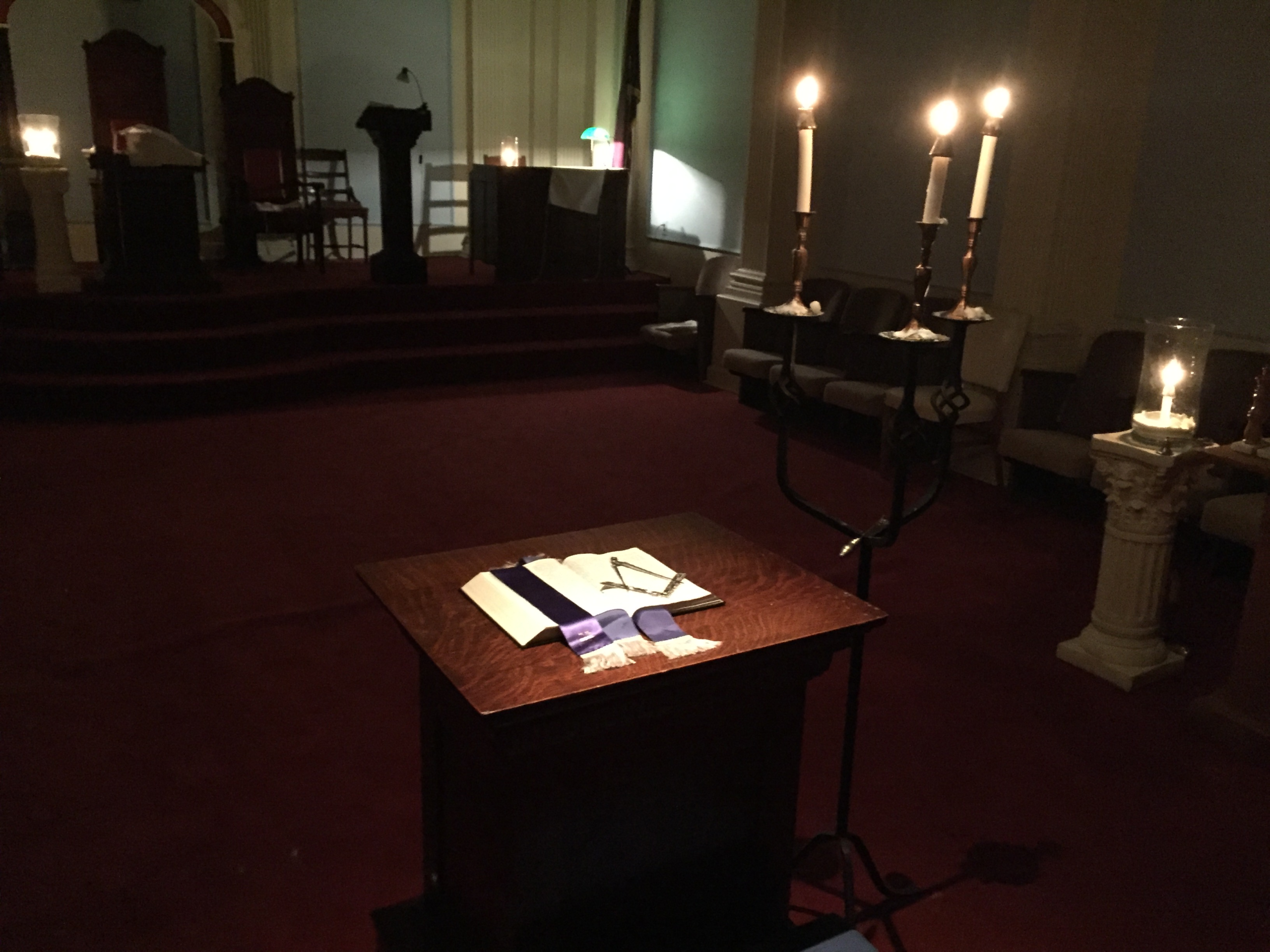
The following is a talk I gave at the Autumn 2024 meeting of Abraham Lodge No. 8 in Louisville, Kentucky, an Observant Lodge that meets quarterly. It was a pleasure to be invited to spend the evening with them and share these thoughts.
In 1853, at the regular Grand Communication of the Grand Lodge of Louisiana, Albert Pike likely rendered the brothers present speechless with a strongly worded three-hour address, which he gave at their request. He had only recently begun the process of recrafting the degrees of the Ancient and Accepted Scottish Rite; indeed, many important snippets from what would later be the degree lectures found their way into the speech. His completed first draft of the Degrees, which we usually term his “Magnum Opus,” was printed and distributed about four years later, yet he asserts that these quotations come from “our lectures.”
Having spent most of my Masonic years in Louisiana, there seems to me to be a kind of immediacy to his words. Clearly he descended upon a state that was deeply divided over what was and was not regular masonry. For example, when talking about how a French Mason is as genuine a Mason as one made in the United States, he said,
I am well aware that this assertion will startle many of our Brethren, and especially those who think that Masonry would die the death, if certain set phrases and peculiar sentences, and particular turns of expressions were forgotten or altered; who think that one is a bright Mason if he can accurately repeat by heart a formal lecture by question and answer, give the degrees according to rule, and open and close the Lodge by the stereotyped formula. I do not undervalue this accuracy. It is useful and proper; but it is no more Masonry, than red-tapeism is statesmanship. It is the soul and spirit of the degrees that really constitute Masonry. The words and phrases are but the body.
Red-tapeism, a word less used today, means adherence and enforcement of strict bureaucratic law that is all letter and no spirit. I am sure his sentiment probably resonates with you, as I know this Lodge to be particularly interested in the spirit and soul of Masonry. I imagine many of you, on visiting other Lodges and hearing ceaseless corrections of memorized ritual, find our emphasis on memory over meaning to be unsatisfactory. Like I frequently tell new Apprentices after their degree, “Despite all appearances, we are not a memorization club. We are an Order of Brothers.” Most Lodges indeed need to articulate better their purposes and agendas.
In this same speech, Pike addresses this articulation issue. He said that Masonry helps a nation advance along three lines: physical, moral, and intellectual. Each of the three paths must advance or backslide, they simply don’t stand still, as society does not stand still. Masonry may advance civilization physically through mutual assistance (so that society at large does not carry so much of the burden). It may advance it morally by requiring its members to perform all the duties they owe to each other and to be true to their word, as well as advancing liberty, equality, and unity in daily life. It may advance it intellectually by teaching its members the deepest truths of philosophy.
Each of these strains really do advance society by advancing the brothers themselves along these lines, and they naturally outflow into the improvement of society. If the Order fails to advance the brothers in even one of these ways, the thing falls apart. It is easy enough to contemplate endlessly on the value of changing the entire world and nevertheless never move in that direction, since it neglects physical and moral improvement. Pike addresses this directly to my Grand Lodge:
We read in Masonic Monitors, of Speculative Masonry, as distinguished from Operative Masonry. The word “Speculative,” as applied to Masonry, is of modern coinage. I confess I shall be glad to see it disused. It always seems to me to involve the idea of talking much, and doing nothing. Masonry is not speculative, but operative. It is work. Good Masonry is to do the work of life. Its natural work is practical life. Its precepts are meant for practical use. It was not meant for the lazy and luxurious, the indifferent or selfish. To long for the regeneration of the human race, and entertain a philanthropy that embraces the whole world, is very pleasant and very easy. The difficulty is, that when Masonry is no more than that, the field to be cultivated is so extensive, that no other crop is raised in any corner of it than weeds.
He is describing “the dizzying effect of freedom” that Kierkegaard is now famous for expressing only a decade before this speech. If the work of the Lodge is to get lost in dreams about the future, then it is not exactly working. So there is a need for specificity.
In Pike’s time as Grand Commander, the AASR defined Masonry as a whole this way: “A continuous advance, by means of the instruction contained in a series of Degrees, toward the Light, by the elevation of the Celestial, the Spiritual, and the Divine, over the Earthly, Sensual, Material, and Human, in the Nature of Man.” That is, Masonry itself is the advance toward the Light. Everything other than the advance itself is something other than Masonry itself. As Pike says, our rituals and activities are the body of Masonry, not the spirit and soul of it.
The Masonic Restoration Foundation defines its goal as restoring “Freemasonry to the historical and philosophical intent of its organizational founders.” This movement has led to the creation of “Observant Lodges.” In these Lodges, Brothers meet in evening semiformal attire, have carefully planned momentous meetings with meaningful presentations, use real fire in their lighting, and conclude the evening with a ritualistic meal. The common word for this, as you all know, was Traditional Observance, based on a book by Andrew Hammer that advocated for this sort of Masonic experience. In the spirit of historical accuracy, it seems Brother Hammer advocated later for the term “observant” only, without the “traditional,” since the point is not reenactment but intentionality and emotional investment.
Observant Masonry as it exists today under the guidance of the Masonic Restoration Foundation is essentially Masonry practiced as if our relationships with each other mattered and as if our shared language as Brothers needed to be used as tools for higher functions, rather than as ends in themselves. It stands in opposition in most ways with the practices of the majority of Blue Lodges in the United States.
The dichotomy between intentional lodges and those that are less so was not foreign to Albert Pike. In his time, Lodges were largely what we see today—though without the themed Edison bulbs (the technology did not exist until 1879, and even so, wasn’t used in Lodges until much later). They were often taking in candidates who were not taught carefully about what Masonry was throughout the process, so they inevitably had plenty of men who would not take their obligations seriously.
Pike’s stance, though, was one of optimism and idealism in the way the Order could work. He said in that speech to Louisiana:
I mean to speak only of what Masonry teaches; and to set up no extravagant pretensions in its behalf. … It has been well and truly said, that even Hypocrisy is the involuntary homage which vice pays to virtue. That Masons do not live up to the teachings of their Order proves only that they are men; that, like other men, they are weak with the frailties of feeble human nature; and that in the never-ceasing struggle with their passions and the mighty circumstances that environ us all, it is often their lot to be discomfited. If the doctrines of Masonry are good, they of necessity have their effect, and are never taught in vain. For not in vain are the winged seeds of Truth ever sown; and if committed to the winds, God sees to it that they take root somewhere and grow.
So clearly, his focus was not so much on decrying the weaknesses of the Order at large, but only that Masonry said certain things, which, if heeded well, would have resulted in the eventual success against evil that Masonry claims to be.
The Craft Masonry that Brother Hammer set out to elevate is “the Masonry of the multitude,” as the 14° puts it. Pike caused that degree to elaborate on this in its publicly available liturgies:
But by degrees the inferior grades of Masonry, “the lesser mysteries,” their teachings narrowed down, and the symbols so interpreted as to suit the common comprehension, so spread abroad that men were indiscriminately admitted, almost without inquiry, and it was forgotten that Masonry was not meant to be a popular but a select and exclusive institution. … Aspirants were admitted in order to gain numbers, or for revenue alone; the degrees were too rapidly conferred, and without a knowledge of the principles or even of the work of the preceding degrees, on the part of the Aspirants; men of little intellect and information swarmed into the Order, and lowered it to their level; others joined it merely through idle curiosity, and wholly disregarded their obligations; frivolous ceremonies were multiplied, and new degrees invented, and large bodies of men calling themselves Masons threw off their allegiance, pretended to a knowledge of the True Word, without possessing it, and invented new rites; so that the Temple of Masonry became an arena of strife and house of contention. It is the history of human folly; and the occupation of the present always is to reenact the follies of the past.
Brother Hammer’s view is actually quite aligned to this. He writes,
Yet in some corners of the Craft it is thought that more men need to be convinced to become Masons in order to save dying Lodges, or simply because some brothers are looking at the Craft in the same way that they might look at any other commercial enterprise. They relate numerical decline—for whatever reason, even if it be the natural result of a decline in population growth—to failure, and then become panicked when the decline is not arrested. In that panic, these brethren are willing to reverse the direction of centuries of initiatory theory and praxis, sacrificing it all in the attempt to seek out new members, rather than having men seek us as they have always done.
In this regard, Pike and Hammer are in agreement: It is bad to recruit masons indiscriminately, and it is the habit of societies, especially after a period of growth, to cling to that growth alone, rather than the work at hand.
Pike and Hammer, however, disagree about the efficacy and purpose of the Ancient and Accepted Scottish Rite, though Pike speaks of what the Order teaches and not on how well or poorly it gets enacted. Hammer is more focused on practice for why he seems to dismiss the Rite.
In Observing the Craft, Hammer wrote that the Ancient and Accepted Scottish Rite was compromised by its need of not working its first three degrees. Pike obviously disagrees, as he saw it as a matter of not only peace but also good government at the time for the Supreme Council not to claim authority over symbolic Lodges.
Hammer claims that the Blue Degrees are essentially the only important part of Masonry, since he believes the other degrees of the AASR to be mere commentaries on them. He writes,
With a special history, and equally special circumstances related to its existence, the question with this body is rather one of excess, and whether that excess is necessary to the full understanding of the Craft degrees—even the Craft degrees of the Scottish Rite—or whether it once again simply distracts us from observing the Craft.
This is an argument from scarcity, not from efficiency. In order for this idea to work, one has to think that there are only a certain number of resources available to a Mason to grasp the lessons of the Order.
Hammer’s main thesis at this point in the book is this: “When the various rituals of English-based Lodges are worked and explained to their ultimate potential, they are every bit as awesome and esoteric as those of the Scottish Rite.” This thesis is largely a question a taste, rather than a full evaluation of the “full” AASR compared to the York or AASR craft degrees. To Observing the Craft’s logic, the Craft Lodge to the full AASR is an apple to a caramel apple; anything added just makes it excessive, even if pleasant.
Pike’s stance differs a bit with Hammer’s. To him, it is more of the difference between a bite of an apple and the whole apple. Were Brother Pike alive to respond to Brother Hammer, he would say, as he did in one of his allocutions to the Supreme Council, “Our instruction and discoveries ought to be jealously retained within our Sanctuaries. Our degrees are not mere commentaries, or commentaries at all, on the Blue Degrees. Legitimate commentary upon these indeed, would be but brief.” He agrees with Hammer that if the rite were just commentaries on the Blue Degrees, then the degrees would be worth that and no more. However, he did not see the AASR as being such a commentary.
Naturally, though, he might not have replied at all to the accusation that the AASR’s degrees distract from the Craft Lodge, as he says in that same allocution, “We do not reply to the ridicule or invectives of those, nor seek to confute or enlighten them, who are content with the Masonry of the Blue Lodges. What they write against the higher degrees can deter none from seeking our Sanctuaries, who are fit to enter them and are wanted.”
These are mostly semantics, though. Hammer and Pike are reacting to different things entirely and would likely agree on this matter after a short conversation.
Onto the main question of the evening: What might Pike have thought about the Observant Lodge movement in the United States were he alive today? Probably the easiest way to examine it is to follow Andrew Hammer’s 2011 document, “Eight Steps for Masonic Restoration,” which is available on the MRF web site.
The first point is “Guarding the West Gate.” To Pike, growth or no growth, the work remains. As Pike put it in that same allocution,
It is in our power to increase the number of our Initiates until they shall be counted by tens of thousands, and yet to maintain unimpaired the distinctive features of our Organization, and to prevent the Order from sinking into that condition of uselessness and decay that wears the delusive mask prosperity which every association has worn for a time after the true initiation had died out in the Sanctuary. But we cannot do this by neglecting the duties of our office, or attending to them only when there is nothing else, of business or amusement, that has superior demands upon our time. We can do it, by exercising wisely all our legitimate authority, not merely to show that we possess it, or out of a desire to rule, but for the benefit and profit of the Brotherhood; by labouring with energy and prudence to extend the Rite not merely by inducing many men to receive the degrees, and then permitting them to neglect the duties and the studies by which alone the true initiation is obtained; but by increasing the number of the true Adepts and real Princes of the Royal Secret, understanding the symbols high degrees, and appreciating the magnificent truths which these symbols were intended to conceal from the many, that they might by diligent study and profound reflection be discovered by the few.
Clearly, Pike agrees with Hammer on this point. If morally base people find their way into a Lodge, then the efforts of the Brothers will get thwarted over and over again.
On the second step, “Being proficient in Masonic Ritual and Law,” Hammer explains that it is good to stick closely to the requirements of the jurisdiction and the wordings of the ritual. Pike of course echoes the former consistently in his installation ceremonies and in his explanations of Masonic law that appear in the allocutions. On the latter matter, though, one actual difference between their expectations, is that in the AASR, proficiency in ritual is in familiarity with the ritual and what it most likely means. In the York Blue Lodges, it is more about the ability to repeat memorized ritual. I don’t need to tell you how much the emphasis on memorization shifts attention from the work of conferring the degree and onto how impressive the memorizer is to everyone. But that is my own bias as an AASR apologist. In the AASR, the rituals are generally supposed to be read from copy, not memorized as is common practice now in the Southern Jurisdiction. Other than that difference in manner, Pike agrees with Hammer here.
The third step is “A commitment to advance brethren through the degrees by mutual and genuine effort.” Hammer claims that if a candidate isn’t willing to attempt to commit things to memory or to write and deliver papers, then he should find some other thing to do with his time than Masonic work. Pike seems to be in agreement, though not with papers exactly, only that the aspirant for each degree should put forth effort at least to learn the basics of each degree before advancing. He said to the Supreme Council in 1866 that “Those only are fit to advance, who succeed in partially comprehending the symbols that surround them.” The fifth degree in Pike’s hand required the aspirant to prove a kind of proficiency in the fourth degree without prompting. The delivery of addresses or research papers is of newer practice, probably following the cues of Quatuor Coronati Lodge in the UGLE, in its interest in settling matters of historical controversy through research papers. Nevertheless, any way a new brother could try to articulate that he has “partially comprehended” the degree he has taken, Pike would certainly have approved of it.
In the fourth step, Hammer rejects the progressive line. Pike, as far as I can tell, never knew of a progressive line practice, but the issue that Hammer notes is that progressive lines take the Lodge’s attention away from the possession of the real trust required to serve in the next highest office. This seems to me to be commonly understood, and clearly, Pike left it without saying as well.
The fifth step is “Dressing Your Best for Lodge.” Pike is actually relatively silent on this one; casual clothing was not a developed concept in the nineteenth century, exactly. He and the Rite are silent on this, except when prescribing what one wears to lodge in the liturgies, such as a black frock coat (equivalent today perhaps to a black suit) in several of the degrees.
The sixth step of Hammer’s document is “A Lodge must offer quality assemblies and be willing to pay for them.” It is common among observant Lodges for annual dues and the degree fees to be considerably higher than the national average, which is probably closer to $90, though I have seen Lodges as inexpensive as $30 a year.
Hammer continues that “the festive board conveys the sense of conviviality that helps build true brotherhood, and it is historically established in the Craft as not merely a simple dinner, but quite honestly the second half of a Lodge meeting. An observant Lodge cannot forego it.” Regarding the period of refreshment, Pike’s Lodge of Perfection Installation ceremony is explicit:
Masonry was intended to be joyous and convivial, and not sour, ascetic and formal. Calling from labor to refreshment originally had a real meaning and a worthy purpose. After their labors, the Brethren gathered round the social and festive board; and there, under the genial influences of the golden hour, all the distrusts and jealousies and piques and slight animosities melted away as thin clouds melt out of the sky in summer. Perhaps nothing has done so much injury to Masonry as the abandonment of this custom, and the substitution of a rigid Puritanism in place of the old good-humored hilarity. In too many places the work is done with a severe solemnity, the debates are conducted with a dull decorum, in which self-sufficiency and conceit often give offense; and when the labors end at last, each with a sigh of relief plods gravely homeward, harboring a vague suspicion, at least, that his evening might have been better passed at the domestic fireside. If any irritation was created by discussion, it remains in his heart to fret and vex him, to swell in its proportions to exasperation and bitterness, which are to find vent hereafter, when it would have flitted away like mist before the sun, during the convivial hour of which our ancient Brethren knew the value.
Score yet another point for Observant Masonry. Pike certainly rejected the Puritanism that has led to the majority practice of eating a dry supper before a meeting and going straight home. Observant Lodges have gotten back into the very useful habit of balancing labor with refreshment by eating after a meeting and not eschewing the moderate consumption of alcohol for those who are able, hence why he made sure to transmit the traditional names of the different alcoholic beverages in the banquet lodge rituals of the Ancient and Accepted Scottish Rite.
On another point of this step, “being willing to pay for them,” Pike praised the AASR bodies in the District of Columbia in 1888 for their degree fees being enthusiastically paid, of, inflated for today, about $6400 for the 29 degrees. He praised bodies for making an effort to procure a respectable building in the same allocution.
Step seven is “The return of a sense of awe to our ceremonies.” Pike said in 1884 that the Order “appeals wholly to the higher moral and intellectual nature of men, and not to their passions or imagination. It is only to a very limited extent dramatic, scenic or sensational, resting its claims to consideration wholly upon its intellectual excellencies and its impressive utterances of great truths.” He was not particularly concerned with shocking candidates with stagecraft. The more meaningful way of practicing Masonry that Hammer advocates for in his book is simply what Pike expected.
Hammer points out that music is one of the ways that we can heighten that sense of awe. This has been a contentious issue for some people, though in practice I have never seen anyone express anything but pleasure when I have requested and succeeded at introducing the indicated music into ritual. Pike’s rituals of course used music, but more than that, much of it was specified through the efforts of Matthew Cooke, our Supreme Council’s Honorary Grand Organist who lived in England in the late nineteenth century. Cooke drafted organ arrangements of all the music for which he saw an indication in the ritual and presented his work in at least four volumes to the Supreme Council. Book one was for the degree receptions themselves, book two was for installations and constitutions, book three was for youth ceremonies like the Louveteau ceremony or Masonic baptism, and book four was for Lodges of Sorrow and the funeral rites. Albert Pike authorized these books in 1881 for use in the jurisdiction. Clearly he was a fan. The readings of the thirtieth degree describe music as probably the most important natural law, as it accounts for connection between the deity and humanity. It is one thing to have the use of language, the ability to persuade, the rational faculties, and the ability to count and measure things, but music starts a new game entirely. The reading says this:
Therefore men began to see, in the revolutions of the spheres all arranged so as never to interfere with each other, in the alternation of the seasons and of the hours for rest and labor, in the eternal genesis of living creatures, in the phenomena of growth, something more than the exercise of mechanical skill on the part of the Creator. They found that musical notes proceeded by octaves and were connected with, and could be represented by, numbers; they connected all musical sounds in nature with one universal harmony and imagined that the spheres, revolving in their orbits, made exquisite MUSIC and thought that the law which made their movement eternal was not two opposing mechanical forces, but One law of Harmony, in which something more than the mechanical genius of the Deity played a part and was the lawgiver. They saw the same law of harmony in the nature of man, in the birth and death of things, in growth and in decay; and thus they connected all the phenomena of nature with the incessant movements of the Stars and made all these the result of that one law of Harmony, which sense the word Music has in this Degree—the Harmony of Equilibrium, resulting everywhere from the opposite action and tendency of contraries.
In this sense, audible music has a kind of heightening element to it that makes it seem like one’s aspirations are ascending to God, similarly to how incense does the same. In my own experience as a Lodge musician, music forces everyone in the room to focus their intentions on the work of the degree, rather than on the various distractions that find their ways into masonic work, such as memorization errors, inappropriate asides by the speaker, or nervous laughter. Pike was clearly aware of this in his employment of music in the rituals, but Observant Lodges care deeply for live music’s power to set time apart from how people typically experience it. That is, people often experience music merely for filling silence or for entertainment. Instead, intentional music making focuses everyone into a space and moment. In my own Observant Lodge back in Baton Rouge, I was asked to compose plainchant-style recitations of the circumambulation scriptures. They seemed to go really well both for focus and for the dissipation of nervous energy. Since I moved to Tennessee, I noticed that they have been substituting Amazing Grace instead of the Pleyel’s Hymn dirge in the Tennessee monitor. I often sing it now with the Master’s permission. It remains for me to teach the song to the Lodges so we can surround the candidate with real song coming from real brothers.
Pike outright rejected the idea our business was merely the creation of new brothers, but that a Master should carefully plot out some real degree of enrichment at every meeting. This clearly aligns with the eighth point from the Eight Steps, “Masonic Education at Every Meeting.” He really impressed this in his final version of the Lodge of Perfection Installation from 1884:
Most of the Brethren of a Lodge sit and look on only as spectators, never joining in debate, and often becoming weary of the same frivolities of discussion, the magnifying of trifles, the much ado about nothing of those who, by motions and objections, by talking out of season, and unprofitably, gratify their sense of their own self-importance. To those who look for instruction, and are hungry and athirst for it, and receive none, Lodge-meetings must become tedious and wearisome, and their interest in Masonry die out. But they will always listen attentively enough to one who tells them anything worth hearing and remembering.
And here we are with Pike approving of every one of the points that Hammer lays out as constituting Observant masonry, only really needing occasional contextualization. Where Pike differs from Hammer generally falls into problems of practice and in the efficacy of the higher degrees. Nevertheless, a brother who carefully follows the traditions transmitted and finalized by Pike will find a familiar home in a York Observant Lodge, knowing that the spirit and soul of it is the same as that of the AASR’s other bodies. He knows that Masonry will not die the death if certain phrases are altered over time, but he also appreciates that the ritual is what delivers our obligations to each other and forms a shared language for us. Let us have faith in the great value of our Degrees and press onward toward the Light together.