

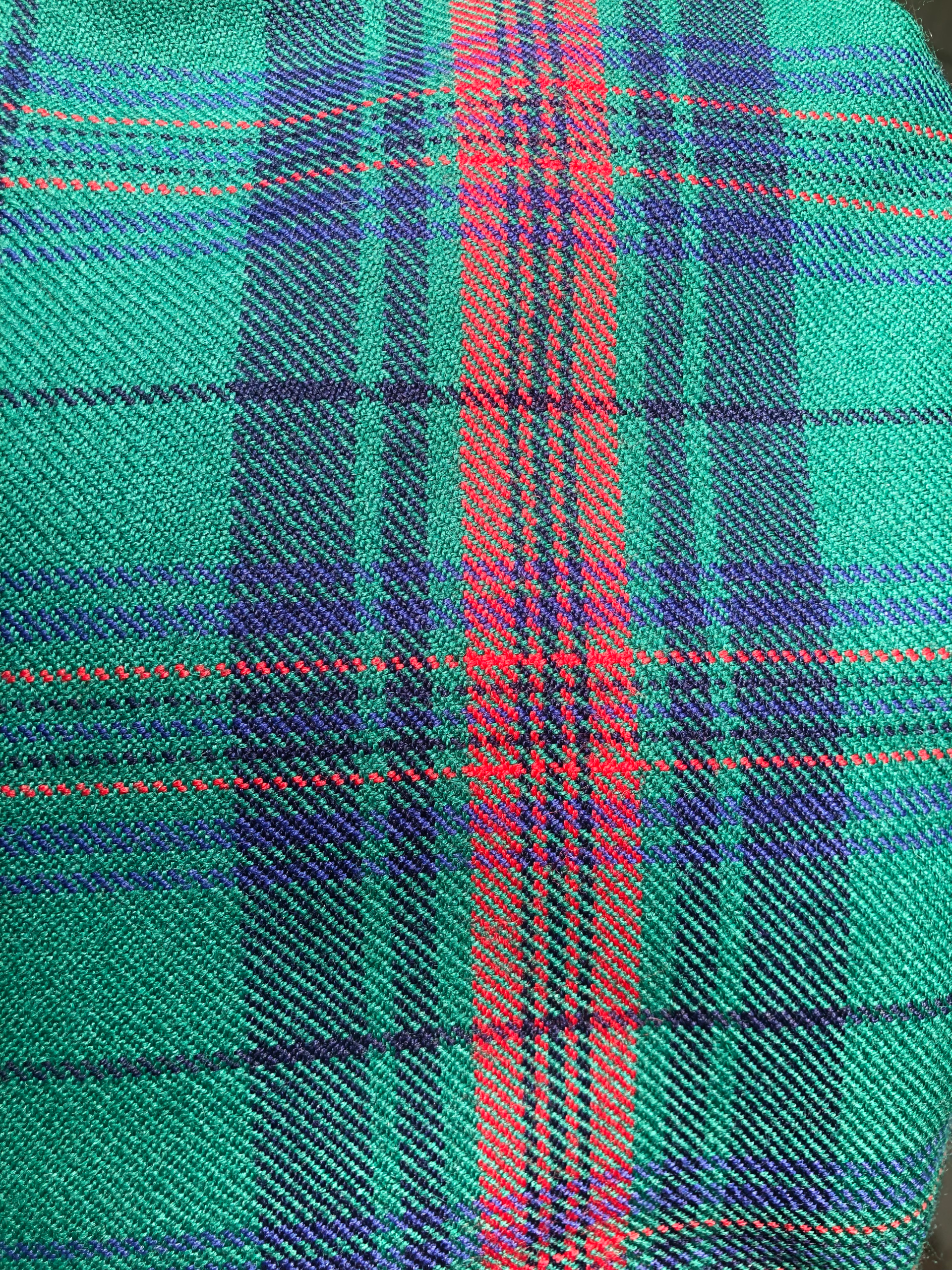
Owen is a Welsh surname that is somewhat popular in the English-speaking world. Like most Welsh surnames, it was originally a first name. Wales (called Cymru in Welsh) was a patronymic culture like Iceland until around the 1400s, when the surnames were frozen or chosen. Instead of there being one big Owen family, it was more the case that there were several men named Owen whose sons had the word “Owen,” “Bowen” (short for “ab Owen”), or “Owens” (same as the English Owen’s in the possessive) after their name to indicate the father.
In other words, there were no “clans” in Cymru like there were in Scotland and like there essentially are in the United States today.
Nevertheless, around the turn of the millennium, Sheila Daniel of the Cambrian Woolen Mill in Powys designed about forty “name” tartans associated with some of the most common last names in Wales, including Owen, Williams, Jones, Evans, Griffith, and so forth. Owen was in this group, registered in the Scottish Register of Tartans as “Owen of Wales” around 2001. They are now exclusively owned and produced from the Wales Tartan Centres in Swansea (Abertawe), who makes some amazing tartan products.
So what is special about these Welsh tartans, of which Owen is one?
A quick way to see the difference is by looking at a Scottish tartan. Here is the thread pattern for the “loud” MacLeod tartan:

When this pattern is made back and forth by pivoting and mirroring the pattern on either side, it produces a thin red stripe and three thick black stripes on a yellow field. When woven, it produces a square pattern, like so:

As a side note, if you find that tartan in polyviscose, the one that you will probably find accidentally made the black field 28 threads wide, which doubles the middle stripe when the pattern is pivoted on itself.
Scottish tartans are square patterns, since the threads going along the warp and those going along the weft are exactly the same. Thus for MacLeod, I just needed to show you one 94-thread pattern. Their combination creates various beautiful patterns, all of which are essentially perfect squares.
Welsh tartans, on the other hand, use a particular pattern of threads in the warp and another pattern in the weft, which generates more rectangular patterns, as well as really prominent stripes.
Let’s examine Owen’s threads, then.

The top bar there is a 63.5-thread pattern that is quite a bit smaller than the one in the bottom bar, which is 130 threads. The top bar has an odd number of threads, which means that at the “pivot,” where the threads appear in reverse order, the top bar ends up with three threads (meaning that it is one-and-a-half threads before the pivot).
If we pivot them on the left side to produce two mirror images, we get this:

If you compare these two quite different patterns, you do see some similarities. Firstly, Owen’s wide green fields are exactly in a 2:1 ratio, which produces the green rectangles boxed in by the lonely navy borders. The feel in both of them is of a prominent center that is flanked by contrasting lines of different widths.
When both are brought together, you get this basic pattern:

When one is accustomed to traditional tartans, this one’s breach of those expectations either appears strangely beautiful or “off.” I’m in the “strangely beautiful” camp.

You can see the prominent stripes when looking at it from a distance. I’ve really enjoyed wearing this stuff out and about. Unless one is particularly knowledgeable about tartans, no one points out the strangeness of the tartan, just the usual “Are you from Scotland?” I usually politely say that I’m not, but I’m a fan. If they look like they want to talk about it for a bit, I’ll go into this whole Welsh thing.
You’ll notice, too, if you know your Highland dress, that the sporran is unusual; it has the animal hair, but no metal cantle. This was another design from the Wales Tartan Centres that makes their dress more particular. They call it an ysgrepan (us-GREH-pahn), which is related to the English word “scrip,” a kind of bag.
I can’t find it anymore, but I read somewhere that this tartan may have this particular color pattern because of its association with the colors of y ddraig goch (the red dragon) and the beautiful green landscape of the Welsh countryside. I dig it. It is also one of the quite rare tartans with a violet (almost indigo) color in it. My own clan tartan, Kennedy, has it as well, but evidently tartans with purple hues have only appeared in the last few years.
