

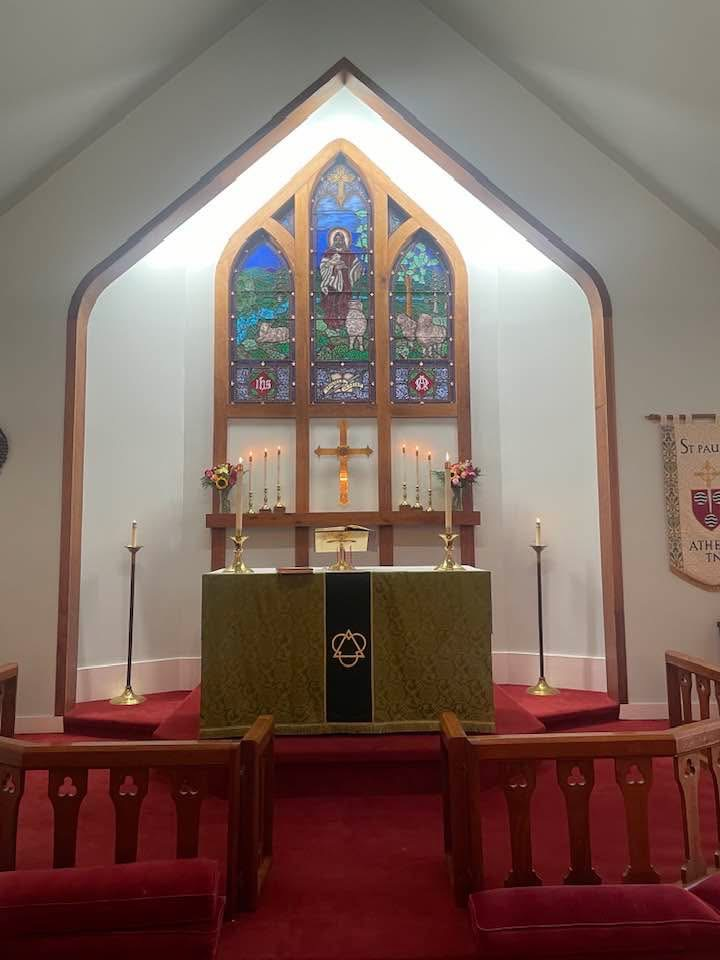
To begin with, the Episcopal Church is quite new to me, other than having sung in a lot of Anglican services with touring choirs during my college days. Earlier this year, I was asked if I may be interested in stepping in as the music director at St. Paul’s Episcopal Church in Athens, Tennessee. I had avoided a church post for a while, enjoying visiting loads of different churches (I think I visited around 30 churches in East Tennessee in my first year here) and the regular Wednesday night bagpipe practice in Chattanooga with the Shriners. However, I knew that this church post would probably be a great deal of fun, so I jumped in. I had already made several friends at that church, not to mention several friends in the Episcopal music circles of Chattanooga through singing with Chorus Angelorum and the Chattanooga Bach Choir. I figured I wouldn’t be a fish out of water entirely.
I was raised Methodist and spent fourteen years serving in one capacity or another at First United Methodist Church in Baton Rouge. That was helpful experience for this job, which consists of quite a bit more than what I learned in music school! So, what have I figured out so far about how to put together the musical side of a Sunday service in these last few months? Here is my current understanding:
An Episcopal Sunday service has two basic parts: the proclamation of the Word (readings, sung responses, sermon, prayers, and so forth) and the Eucharist (a reenactment of Jesus’s last supper with his disciples).
Generally, two hymns happen in the proclamation of the word section and two hymns happen in the communion section. The Episcopal Church has resources to narrow down hymns to usually about 40 applicable options in its three usual hymnals, The Hymnal 1982, Wonder, Love, and Praise, and Lift Every Voice and Sing II. The fun is choosing hymns that draw the most direct connections to the lectionary readings and the emphases that will likely occur, keeping them accessible but still interesting. Sometimes that involves putting a good text to a more familiar tune thanks to bulletin inserts!
The first section of the service consists most reliably on four scriptural readings that are set by the lectionary. If one wanted to deliver another lesson than that from the lectionary, it would require permission from the Bishop, who presides over the region, called a diocese. Before the scriptures are things that prepare us to hear it: a prelude, a processional hymn with relevant text, an opening acclamation, a collect (prayer) for purity, a “Gloria” or hymn of praise, and a daily collect (set by the Book of Common Prayer, which orders the rituals of the Episcopal Church). That primes everyone up for being in the right mental and emotional place to hear and read the lessons. We read three first, usually an Old Testament reading immediately followed by a psalm (usually read responsively, but one can deliver a psalm in any appropriate way), which is immediately followed by a reading from the New Testament that isn’t the Gospel. The people respond to those first readings with a hymn, which we call a “sequence hymn,” since it both responds to everything before it and prepares us for what follows. What follows is the prescribed reading from the gospel, to which we respond with a very brief musical reflection on it. Next is a sermon that comments on the readings and contextualizes them for the people. Next is the Nicene Creed, followed by a set of prayers, which are enunciated by a pre-selected group of readings scattered around the room. What follows is a prescribed prayer of confession and one of absolution, then the passing of the peace, which asserts that everyone in the room is in right relation one with the other before proceeding to the second part of the service (the supper).
So here’s today’s readings and responses to get a sense of it.
The bell rang, which cued the pianist to play “A Mighty Fortress Is Our God,” as a piano prelude to the service. The organ then played hymn 594, “God of grace and God of glory,” set to the Welsh tune Cwm Rhondda (pronounced koom hron-dhah, dh being the “th” in “that”). Here are the words of Harry Emerson Fosdick:
God of grace and God of glory, on thy people pour thy power; crown thine ancient Church’s story; bring her bud to glorious flower. Grant us wisdom, grant us courage, for the facing of this hour.
Lo! The hosts of evil round us scorn thy Christ, assail his ways! From the fears that long have bound us free our hearts to faith and praise: grant us wisdom, grant us courage, for the living of these days.
Cure thy children’s warring madness, bend our pride to thy control; shame our wanton, selfish gladness, rich in things and poor in soul. Grant us wisdom, grant us courage, lest we miss thy kingdom’s goal.
Save us from weak resignation to the evils we deplore; let the gift of thy salvation be our glory evermore. Grant us wisdom, grant us courage, serving thee whom we adore.
Why did I choose this as an opening hymn? For one, the tune is full of life, including a rousing dominant seventh chord with repeated text in inner parts before a final repetition. The United Methodist Hymnal has the altos and basses line out that triad, but in the Hymnal 1982, those figures are just organ cues. What’s to stop me, though, from having the choir do them anyway? It lends a great deal of gusto. It is also familiar enough that most folks feel comfortable singing along.
So that’s the tune, what about the words? They relate directly to the readings and the collect of the day. It points out that the world is full of things that will divide the church or cause it to sink into apathy and discouragement. So this mirrors the Collect of the Day,
“Let your continual mercy, O Lord, cleanse and defend your Church; and, because it cannot continue in safety without your help, protect and govern it always by your goodness; through Jesus Christ our Lord, who lives and reigns with you and the Holy Spirit, one God, for ever and ever. Amen.”
It asks God to save us from all the evils around us. This echoes the first reading, “I saw all the deeds that are done under the sun; and see, all is vanity and a chasing after wind.” It echoes the psalm, “Why should I be afraid in evil days, when the wickedness of those at my heels surrounds me?”
It asks God to save us from all the evils within us, especially love of wealth (“shame our wanton, selfish gladness, rich in things and pure in soul”). This echoes the first reading, which decries toil for earthly purposes. It echoes the psalm, which likens the wise to the foolish in what happens to the body at death. It echoes the second lesson, “seek things that are above, where Christ is,” as well as “Put to death, therefore, whatever in you is earthly,” not to mention, “But now you must get rid of all such things—anger, wrath, malice, slander, and abusive language from your mouth.”
It asks God for help to maintain the mission of the Church to forge ahead despite the warring madness of the people by asking for wisdom from God. Specifically, we ask God to bend our pride to his control. This echoes the first lesson, which asserts that seeking wisdom is toilsome. It echoes the psalm, which says “My mouth shall speak of wisdom, and my heart shall meditate on understanding” and “For we see that the wise die also; like the dull and stupid they perish and leave their wealth to those who come after them.”
And after all of that, it prefaces our collect of purity (“Almighty God, to you all hearts are open, all desires known, and from you no secrets are hid: Cleanse the thoughts of our hearts by the inspiration of your Holy Spirit, that we may perfectly love you, and worthily magnify your holy Name; through Christ our Lord. Amen.”). It asks for God to pour his power on the Church, to free hearts from fears, and to let the gift of God’s salvation be our glory. It’s all already in that hymn.
So following that hymn is the opening acclamation, “Blessed be God: Father, Son, and Holy Spirit. And blessed be his kingdom, now and forever. Amen.” Then the Collect for Purity I just quoted.
Then we squeeze in a stanza of music of praise, partly as a response to that collect of purity. This piece usually stays there for several Sundays in a row. Right now, it is Charles Wesley’s “Rejoice, the Lord is King! Your Lord and King adore! Mortals, give thanks and sing, and triumph evermore! Lift up your heart! Lift up your voice! Rejoice! Again I say, rejoice!” to the tune Gopsal by Handel, a contemporary of the Wesley brothers. Read the text as speech. It’s full of imperatives to be full of joy. Such joy makes sense immediately after that collect for purity.
Then follows the Collect of the Day, which I’ve already quoted. Then the lessons:
First Lesson: Ecclesiastes 1:2, 12-14; 2:18-23
Vanity of vanities, says the Teacher, vanity of vanities! All is vanity.
I, the Teacher, when king over Israel in Jerusalem, applied my mind to seek and to search out by wisdom all that is done under heaven; it is an unhappy business that God has given to human beings to be busy with. I saw all the deeds that are done under the sun; and see, all is vanity and a chasing after wind.
I hated all my toil in which I had toiled under the sun, seeing that I must leave it to those who come after me—and who knows whether they will be wise or foolish? Yet they will be master of all for which I toiled and used my wisdom under the sun. This also is vanity. So I turned and gave my heart up to despair concerning all the toil of my labors under the sun, because sometimes one who has toiled with wisdom and knowledge and skill must leave all to be enjoyed by another who did not toil for it. This also is vanity and a great evil. What do mortals get from all the toil and strain with which they toil under the sun? For all their days are full of pain, and their work is a vexation; even at night their minds do not rest. This also is vanity.
Then the Psalm: Psalm 49:1-11
Hear this, all you peoples; hearken, all you who dwell in the world, you of high degree and low, rich and poor together. My mouth shall speak of wisdom, and my heart shall meditate on understanding. I will incline my ear to a proverb and set forth my riddle upon the harp. Why should I be afraid in evil days, when the wickedness of those at my heels surrounds me, the wickedness of those who put their trust in their goods, and boast of their great riches? We can never ransom ourselves, or deliver to God the price of our life; For the ransom of our life is so great, that we should never have enough to pay it, in order to live for ever and ever, and never see the grave. For we see that the wise die also; like the dull and stupid they perish and leave their wealth to those who come after them. Their graves shall be their homes forever, their dwelling places from generation to generation, though they call the lands after their own names. Even though honored, they cannot live forever; they are like the beasts that perish.
(Both of these are the “Gospel-Related” second track of readings allowable in the Episcopal lectionary during the long “green” season. The other is “Semi-Continuous,” which covers more of the Bible over the course of the year.)
A second reader then reads the Second Lesson: Colossians 3:1-11
If you have been raised with Christ, seek the things that are above, where Christ is, seated at the right hand of God. Set your minds on things that are above, not on things that are on earth, for you have died, and your life is hidden with Christ in God. When Christ who is your life is revealed, then you also will be revealed with him in glory.
Put to death, therefore, whatever in you is earthly: fornication, impurity, passion, evil desire, and greed (which is idolatry). On account of these the wrath of God is coming on those who are disobedient. These are the ways you also once followed, when you were living that life. But now you must get rid of all such things—anger, wrath, malice, slander, and abusive language from your mouth. Do not lie to one another, seeing that you have stripped off the old self with its practices and have clothed yourselves with the new self, which is being renewed in knowledge according to the image of its creator. In that renewal there is no longer Greek and Jew, circumcised and uncircumcised, barbarian, Scythian, slave and free; but Christ is all and in all!
So we’ve had those three readings, all dealing with wisdom, the evils of the people both within and without, the vanity of earthly wealth and power, and the riddles that wisdom itself does not pose a natural benefit to the earthly self. This leads us to the Sequence Hymn. I picked William Boyd Carpenter’s text, “Before thy throne, O God, we kneel” to the stately and sweeping tune St. Petersburg, by the Russian composer Dmitri Bortniansky:
Before thy throne, O God, we kneel: give us a conscience quick to feel, a ready mind to understand the meaning of thy chastening hand; whate’er the pain and shame may be, bring us, O Father, nearer thee.
Search out our hearts and make us true; help us to give to all their due. From love of pleasure, lust of gold, from sins which make the heart grow cold, wean us and train us with thy rod; teach us to know our faults, O God.
For sins of heedless word and deed, for pride ambitious to succeed, for crafty trade and subtle snare to catch the simple unaware, for lives bereft of purpose high, forgive, forgive, O Lord, we cry.
Let the fierce fires which burn and try, our inmost spirits purify: consume the ill; purge out the shame; O God, be with us in the flame; a newborn people may we rise, more pure, more true, more nobly wise.
So this text confirms the ideas set forth in the previous readings. It is a second call to wisdom, understanding, and proximity to God. The reference to “lust of gold” probably most previews the next reading. It introduces this Gospel reading, Luke 12:13-21:
Someone in the crowd said to Jesus, “Teacher, tell my brother to divide the family inheritance with me.” But he said to him, “Friend, who set me to be a judge or arbitrator over you?” And he said to them, “Take care! Be on your guard against all kinds of greed; for one’s life does not consist in the abundance of possessions.” Then he told them a parable: “The land of a rich man produced abundantly. And he thought to himself, ‘What should I do, for I have no place to store my crops?’ Then he said, ‘I will do this: I will pull down my barns and build larger ones, and there I will store all my grain and my goods. And I will say to my soul, ‘Soul, you have ample goods laid up for many years; relax, eat, drink, be merry.’ But God said to him, ‘You fool! This very night your life is being demanded of you. And the things you have prepared, whose will they be?’ So it is with those who store up treasures for themselves but are not rich toward God.”
Now all musical responses afterward ideally relate to the Gospel reading, even during communion.
So this passage deals with attachment to wealth, and good stewardship of whatever wealth comes into your trust. I am following the Gospel reading for a few Sundays with the refrain of “Thy word is a lamp unto my feet and a light unto my path” by Michael W. Smith and Amy Grant (a nod to the late 1980s contemporary Christian world that may still be rattling around in the emotional memories of the people). So this particular time, it feels like a response to “So it is with those who store up treasures for themselves but are not rich toward God.” In any case, it responds to any reading with equal relevance.
What follows is the sermon, the Nicene Creed, the prayers of the people, the confession, absolution, and the peace. Once everyone is in right relation, we begin the second part of the service with an offertory. This is music designed to prelude communion; while it is sung or played, the elements are brought to the altar from the people, as well as any other gift-giving ritual that may take place in that spot. So for this Sunday, we went with a solo setting by John Ness Beck of “O Love that wilt not let me go,” a text by George Matheson from 1882.
O Love, that wilt not let me go, I rest my weary soul in thee; I give thee back the life I owe, that in thine ocean depths its flow may richer, fully be. O joy that seekest me through pain, I cannot close my heart to thee; I trace the rainbow through the rain, and feel the promise is not vain, that morn shall tearless be.
This text works well with the Gospel, since it has to do with proximity with God, which is not only what it means to be “rich in God,” but also what it means to commune during communion. The text also deals with the end times, whose source in Revelation is where a lot of the communion ritual comes from.
Following the offertory is what in many churches we call the “Doxology,” though we use the term “Presentation Hymn.” The priest and I went with the second stanza of James Montgomery’s text “O bless the Lord, my soul!” to the tune St. Thomas:
O bless the Lord, my soul! God’s mercies bear in mind! Forget not all God’s benefits! The Lord to thee is kind.
It’s a call to commune with God, which when paired with the idea of the “presentation” of the offerings, is saying that the gifts are his due.
What follows is the ritual of the Great Thanksgiving, which here often includes chant, which the priest chooses. We settled on William Mathias’s setting of the Sanctus, which is quite thrilling and modern. The text itself comes from Isaiah 6, from a vision of God being surrounded by six-winged seraphim who are loudly singing those words, “Holy, holy, holy Lord, God of power and might, heaven and earth are full of your glory. Hosanna in the highest.” Then a second part, from what the people said to Jesus during his entry into Jerusalem, “Blessed is he who comes in the name of the Lord. Hosanna in the highest.” The point here is to “join our voices with angels and archangels and with all the company of heaven” in this very specific praise formula together. Our strategy has been to make sure that the tune is easy enough not to distract from the text and the significance of the moment.
There is a bit more chant, then the Lord’s Prayer, followed by the breaking of the bread, which we respond do with a “Fraction anthem.” Today we went with “Be known to us, Lord Jesus, in the breaking of the bread.”
Then begins communion, which is accompanied by a hymn. It needs to be a text that relates to the act of sharing the holy meal, but even better it is if it relates to the Gospel reading. I went with F. Bland Tucker’s translation of an ancient Greek text, set to Rendez à Dieu, a 1551 tune by Louis Bourgeois, the French Calvinist composer and music theorist:
Father, we thank thee who hast planted thy holy Name within our hearts. Knowledge and faith and life immortal Jesus thy Son to us imparts. Thou, Lord, didst make all for thy pleasure, didst give us food for all our days, giving in Christ the Bread eternal; thine is the power, be thine the praise. Watch o’er thy Church, O Lord, in mercy, save it from evil, guard it still, perfect it in thy love, unite it, cleansed and conformed unto thy will. As grain, once scattered on the hillsides, was in this broken bread made one, so from all lands thy Church be gathered into thy kingdom by thy Son.
This text echoes the collect for purity, echoes the collect of the day to “defend your Church,” answers Solomon’s questions of vanity in the first lesson (What’s the point of toil? For God’s pleasure!), echoes the psalm’s call to knowledge and faith, rearticulates the second lesson’s “Christ is all and in all” with the bread and Church being made one in a similar way, asks like the second lesson to save us from evil, attribute God as the source of all good gifts as the Gospel lesson does, and praises the Name that is in the Great Thanksgiving ritual.
What follows is the Post-communion prayer, which is the “Lord, make us instruments of your peace,” passage, which has been used throughout these green Sundays after Pentecost.
Now the closing hymn, which needs to be reasonably catchy so that it stays with the congregation throughout the day (and maybe week). It summarizes some overall idea from the service, but also comments a bit on the renewed proximity to God achieved through communion. Today I picked out “All my hope on God is founded,” a text by Robert Seymour Bridges and set to the tune Michael, by Herbert Howells, named after Howells’s son who had died in childhood.
All my hope on God is founded; he doth still my trust renew, me through change and chance he guideth, only good and only true. God unknown, he alone calls my heart to be his own.
Mortal pride and earthly glory, sword and crown betray our trust; though we care and toil we build them, tower and temple fall to dust. But God’s power, hour by hour, is my temple and my tower.
God’s great goodness e’er endureth, deep his wisdom passing thought: splendor, light, and life attend him, beauty springeth out of nought. Evermore from his store newborn worlds rise and adore.
Daily doth th’almighty Giver bounteous gifts on us bestow; his desire our soul delighteth, pleasure leads us where we go. Love doth stand at his hand; joy doth wait on his command.
Still from earth to God eternal sacrifice of praise be done, high above all praises praising for the gift of Christ, his Son. Christ doth call one and all: ye who follow shall not fall.
“Mortal pride and earthly glory” directly refers to the Gospel reading. “Sword and crown betray our trust,” refers to the psalm’s “Why should I be afraid in evil days, when the wickedness of those at my heels surrounds me.” “Christ doth call one and all” refers to the second lesson’s “but Christ is all and in all.” “Deep his wisdom passing thought” refers to the heavenly wisdom that Solomon feels the lack of in his reflections in the first reading. The last statement “ye who follow shall not fall” is the holy opposition to Solomon’s “For all their days are full of pain” and the psalm’s “For we see that the wise die also; like the dull and stupid they perish.”
Following the final blessing is an instrumental postlude, which today, the pianist chose as “Just a closer walk with thee,” another appropriate text for the idea of divine proximity.
So the Episcopal liturgy has this rhythm to it—a constant conversation among the past, present, and future. I’m only starting in this effort, but this is how it makes sense to me at the moment. There are resources all over the place that suggest hymns, which speeds along the programming process, nevertheless all kinds of surprising connections appear left and right.
All that to say, it’s a fun task where we get to use art to connect people to the transcendent. We have a vast collection of sources that thread together to good use each week. Lovely to be a part of it. Whatever we can do to bring both familiarity and newness to the people through a good mixture of music helps them to join their voices “with Angels and Archangels.”