Category: Athenian Life

  • Advent Choral Evensong at St. Paul’s Episcopal Church

    Advent Choral Evensong at St. Paul’s Episcopal Church

    December 7, 2025

    I registered about seven months ago that there was some interest in having a choral evensong service at the church, as it had last been done (I am told) before the pandemic. In a choir that sings so much music already on Sunday mornings, it takes a bit of strategy to get a special service learned. Evensongs are absolutely whirlwinds, but as I told the choir, to the congregation, the service feels like a gentle breeze on the backs of their necks. Below is the order of worship.

    For it, I borrowed the introduction from an order I saw at St. Paul’s London, used the older ritual, and made sure the directions were as clear as possible.

    Without any music at all, evensong probably lasts fifteen minutes. With music, it takes about 50 minutes to an hour. So the last several Wednesday night choir rehearsals, I rehearsed the choir on the Evensong music. Then I brought in four or five strong readers from other churches (one or two in each section) to run through the whole thing with us the previous Thursday evening. Everyone seemed pretty enthusiastic the whole time. It’s a wonderfully loving group.

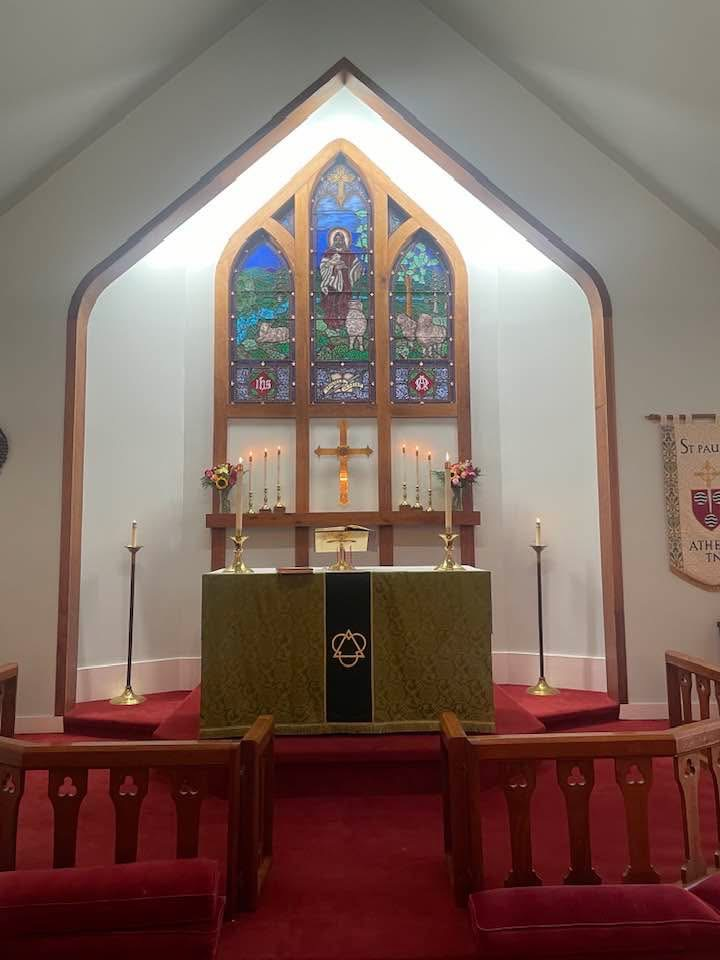
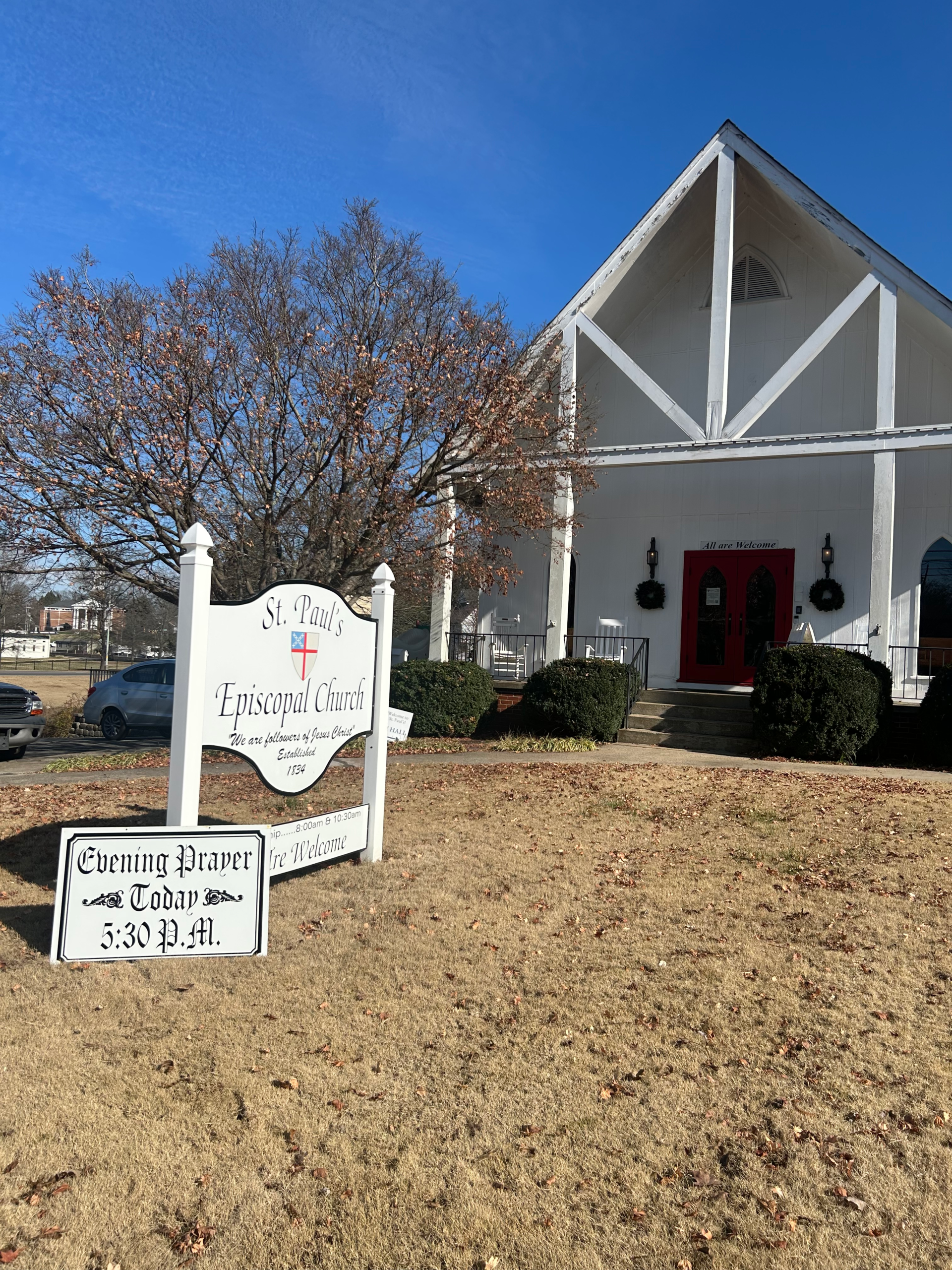
    Sunday arrived, we sang our morning service, I found an old metal Evensong sign, placed it under our church sign, and began getting ready for the evening. I wore my doctoral hood over the cassock and cotta (I’m told this is a common practice in this tradition). The rector wore her blue cope, tippet, etc. I dimmed the nave lights about halfway down, had the candle sconces along the walls filled and lit, put the two hymn numbers in the wooden sign up front, then when 4:30 hit, I rehearsed the preces and responses with the rector and choir. Then we timed the psalm chant one more time and ran the anthem. From there, we robed up our guests and began the service with an exquisite new work by Frederik Magle for clarinet and organ. To get the congregation’s attention, right on the nose of 5:30, I rang the bell outside (my first time on the task!). The choir sang the whole service from behind the congregation, so what they saw was the full text itself and a dark, candlelit altar at the front.

    It was a lovely service with lots of space for prayer, contemplation, and loitering among the ideas of Advent. This was hopefully a nice break from the wild holiday rush, the breaks in routines, the rise of stressful familial expectations, and the reminders of sad changes in relationships that might have happened since the previous year. Here’s a recording of it all. Credit for recording goes to Jacob Efaw, one of my voice students.
  • TWU Lessons and Carols 2025

    TWU Lessons and Carols 2025

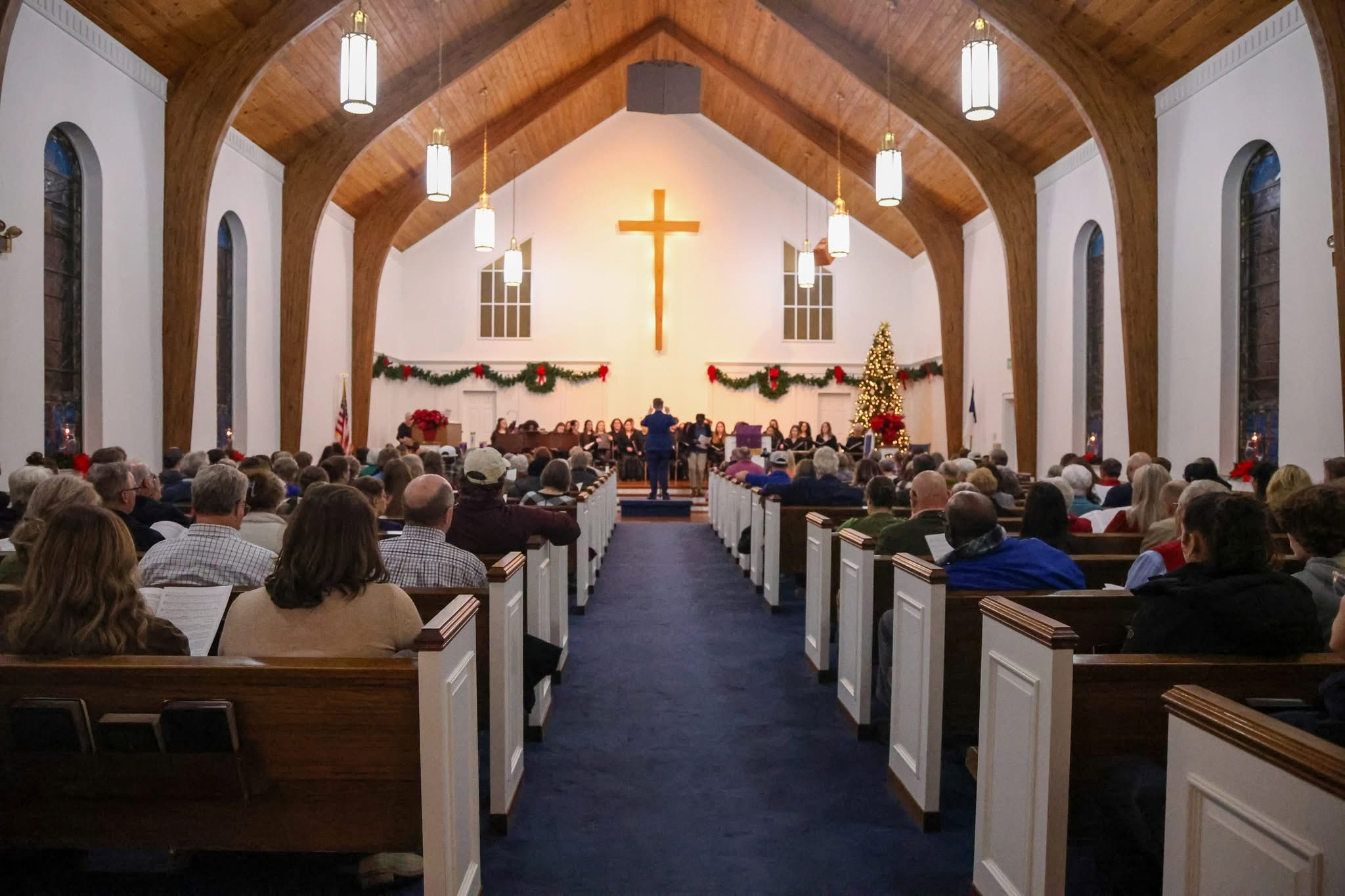
    December 2, 2025, was our Lessons and Carols service at Tennessee Wesleyan. This is always an absolute treat to put together—the community rallies behind it, the faculty show great support for it, and the students seem to enjoy tackling some tough pieces and discovering their relations to the texts that they respond to.

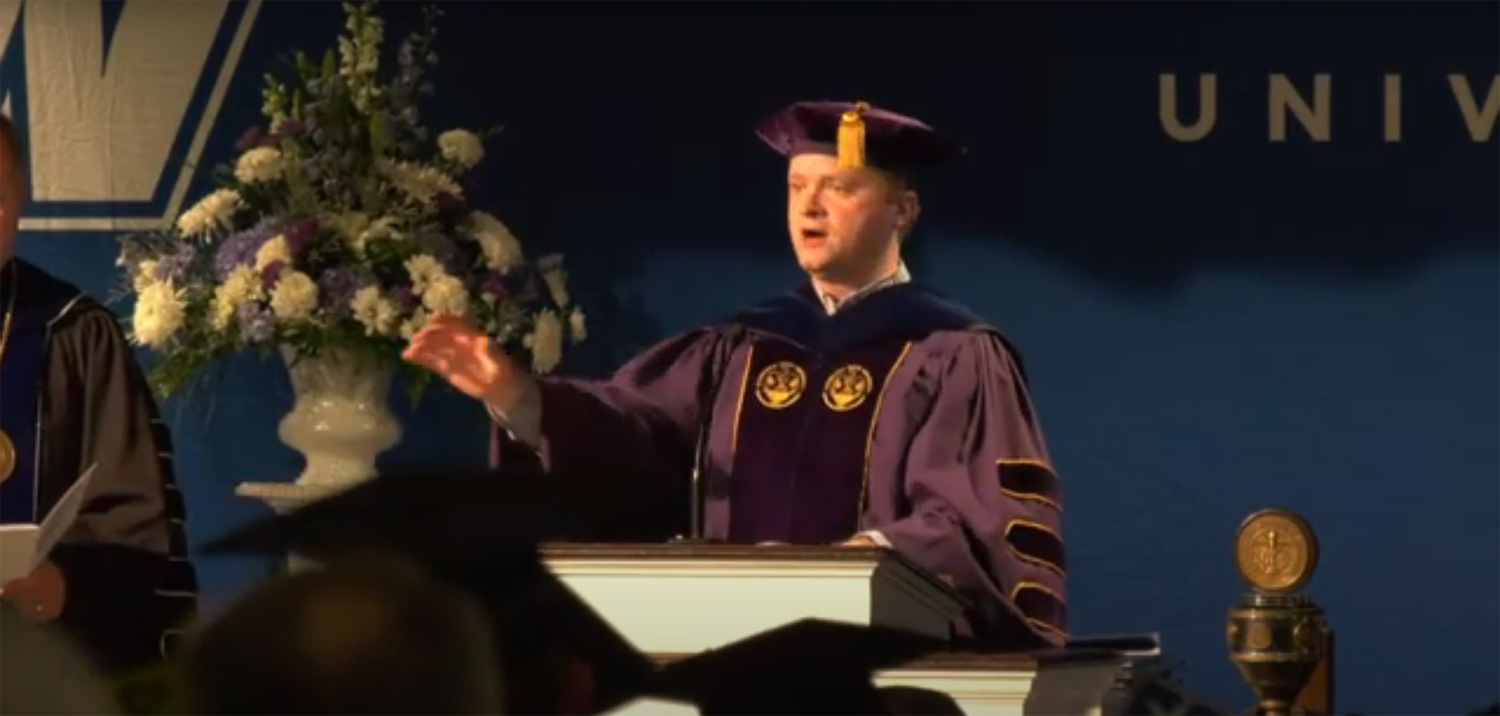
    There are parts of the service that stay the same each year by design, which helps a sense of ritual for regular attendees. I went with King James language throughout the readings, had professors and administrators (including the university president) read, got to enjoy some great percussion from one of our music minors on djembe, had the congregation sing several hymns (all provided in the program). Several students had never performed for such a large audience or sung this sort of music—and in general, they learned the whole hour-and-a-half concert in a month and change. We had to cut the Willan carol for an emergency absence in the second soprano section.

    All in all, it was a successful, human, loving, and fun event, including the famous Josquin motet “Ave Maria … virgo serena” (we went with the Italian Latin pronunciation and a bit of piano help), a bit of Whitacre (“The people that walked in darkness have seen a great light” gets a nice response by “Lux aurumque”), a piece by ElizaBeth Beckham (a dear friend from my undergrad years in the Mississippi Delta), some nice solo opportunities for several singers, and, I am told, several long-lasting smiles from the audience.

  • Dual Voice Recital in Athens

    Dual Voice Recital in Athens

    My wife and I were invited to sing a recital of solo music at Keith Memorial United Methodist Church on September 28 at 5 p.m. as part of a diverse concert series. It was a lovely evening with a loving and attentive audience—about 100 people (mostly local friends but a few far away guests as well) came by.

    Here is the program.

    Here is the audio:

    Jamey sang all of “A Woman’s Life and Love” by Adelbert von Chamisso and Robert Schumann. I admit I had never sat and followed along with this amazing song cycle before. Just exquisite and human. I got to sing a bit of Welsh and Russian, as well as sundry other things. Enjoy!

  • The Alma Mater of Tennessee Wesleyan University

    The Alma Mater of Tennessee Wesleyan University

    When I arrived at Tennessee Wesleyan University, I was pleased to hear that the Alma Mater tune I heard at my first summer commencement used a gorgeous tune called Hyfrydol (a Welsh word, pronounced “huh-VRUH-doll,” meaning “lovely”). Folks who sing hymns regularly know this tune as “Come, Thou Long-Expected Jesus,” “God the Spirit, Guide and Guardian,” “Alleluia! Sing to Jesus!” and “Love Divine, All Loves Excelling.”

    In 2016, Tennessee Wesleyan College became Tennessee Wesleyan University. This name change rendered the previous Alma Mater useless, since it had a rhyme on the “C” of “T. W. C.”

    Our strong band can ne’er be broken
    Formed at T. W. C.
    Far surpassing wealth unspoken
    Sealed by loyalty.

    Refrain
    Lift the chorus, speed it onward,
    Loud her praises be;
    Hail to thee our Alma Mater!
    Hail to T. W. C.

    School life here at best is passing,
    Fast the moments flee.
    Let us pledge in work and deed
    Our love for T. W. C.

    Refrain

    One of the music professors, Keith Wheeler, adapted the old Alma Mater (which was using Cornell’s Alma Mater tune) to conform to the school’s new name, and chose Hyfrydol for its new tune. This single verse served us well for several years, but it always struck me as a bit too short at one verse:

    Our strong band can ne’er be broken
    formed at Tennessee Wesleyan.
    Far surpassing wealth unspoken,
    Light and Truth united as one.
    Lift the chorus, speed it onward,
    let us pledge in word and deed:
    Hail to thee, our Alma Mater,
    loud her praises ever be.

    “Light and Truth” is a reference to our university motto, “Lux et veritas.” He also fixed “work and deed,” which made little sense. The whole second stanza was omitted, since it was a bit depressing. It isn’t as important to remember how fleeting the school days are, I think, but rather to invest in each other and to the program to grow in life, which includes those school days. Life happens wherever you are, after all.

    There are some natural challenges with this text, such as having a dactyl “Tennessee” that does not sound natural anywhere you thread it into the tune, other than to speed up the rhythm on just that one word. To write a second verse, I would need to mimic that dactyl in the same spot. The same thing happens at “united as.” Thus the text doesn’t conform exactly to the 8.7.8.7D (eight syllables, seven syllables, eight, seven, double) meter that Hyfrydol typically uses. Instead, it is technically LM (four eight-syllable lines) followed by 8.7.8.7.

    So on a lark, I started drafting a second verse to lengthen the song and express more of what goes on at our ceremonies. Here’s what I came up with:

    Our best memories live surrounded
    By the hackberry and the oak.
    May our lives, like them, be grounded,
    Deeper roots in Truth we invoke.
    Let each spark begin to glimmer,
    Every falsehood we will shed;
    Let the Light within us shimmer,
    Then from mountains will it spread.

    So, here, I’ve retained the dactyl with “hackberry” and with “Truth we in-,” so that the two stanzas follow the same pattern. The hackberry and oak are two symbols of the university represented in a legend about star-crossed lovers being buried underneath those two trees. It is also on the seal of the university as two crossed boughs with their respective leaves. So I refer to them as symbols of being deeply stable through anchoring to Truth. The second half deals with something we symbolize each year through our honor code signing ceremony and the commencement ceremony, when we light candles as a faculty and pass them on to the graduates while a song is sung. Mountains obviously refers to our situation within the foothills of the Appalachian mountains.

    So here’s the tune:

    It has been received well. Hopefully it maintains a sense of idealism to the work done learning the liberal arts.

  • Tennessee Wesleyan Fight Song

    Tennessee Wesleyan Fight Song

    At some point, one of the alumnae of Tennessee Wesleyan University shared a handwritten manuscript of a fight song for our school. No one had heard of it, so I typeset it and inserted it into our annual Homecoming concert last October. It looked like this:

    When the concert came, our accompanist improvised a lovely piano part for it and we gave it a solid go:

    Fight! Fight!

  • What goes into hymn selection for an Episcopal service?

    What goes into hymn selection for an Episcopal service?

    To begin with, the Episcopal Church is quite new to me, other than having sung in a lot of Anglican services with touring choirs during my college days. Earlier this year, I was asked if I may be interested in stepping in as the music director at St. Paul’s Episcopal Church in Athens, Tennessee. I had avoided a church post for a while, enjoying visiting loads of different churches (I think I visited around 30 churches in East Tennessee in my first year here) and the regular Wednesday night bagpipe practice in Chattanooga with the Shriners. However, I knew that this church post would probably be a great deal of fun, so I jumped in. I had already made several friends at that church, not to mention several friends in the Episcopal music circles of Chattanooga through singing with Chorus Angelorum and the Chattanooga Bach Choir. I figured I wouldn’t be a fish out of water entirely.

    I was raised Methodist and spent fourteen years serving in one capacity or another at First United Methodist Church in Baton Rouge. That was helpful experience for this job, which consists of quite a bit more than what I learned in music school! So, what have I figured out so far about how to put together the musical side of a Sunday service in these last few months? Here is my current understanding:

    An Episcopal Sunday service has two basic parts: the proclamation of the Word (readings, sung responses, sermon, prayers, and so forth) and the Eucharist (a reenactment of Jesus’s last supper with his disciples).

    Generally, two hymns happen in the proclamation of the word section and two hymns happen in the communion section. The Episcopal Church has resources to narrow down hymns to usually about 40 applicable options in its three usual hymnals, The Hymnal 1982, Wonder, Love, and Praise, and Lift Every Voice and Sing II. The fun is choosing hymns that draw the most direct connections to the lectionary readings and the emphases that will likely occur, keeping them accessible but still interesting. Sometimes that involves putting a good text to a more familiar tune thanks to bulletin inserts!

    The first section of the service consists most reliably on four scriptural readings that are set by the lectionary. If one wanted to deliver another lesson than that from the lectionary, it would require permission from the Bishop, who presides over the region, called a diocese. Before the scriptures are things that prepare us to hear it: a prelude, a processional hymn with relevant text, an opening acclamation, a collect (prayer) for purity, a “Gloria” or hymn of praise, and a daily collect (set by the Book of Common Prayer, which orders the rituals of the Episcopal Church). That primes everyone up for being in the right mental and emotional place to hear and read the lessons. We read three first, usually an Old Testament reading immediately followed by a psalm (usually read responsively, but one can deliver a psalm in any appropriate way), which is immediately followed by a reading from the New Testament that isn’t the Gospel. The people respond to those first readings with a hymn, which we call a “sequence hymn,” since it both responds to everything before it and prepares us for what follows. What follows is the prescribed reading from the gospel, to which we respond with a very brief musical reflection on it. Next is a sermon that comments on the readings and contextualizes them for the people. Next is the Nicene Creed, followed by a set of prayers, which are enunciated by a pre-selected group of readings scattered around the room. What follows is a prescribed prayer of confession and one of absolution, then the passing of the peace, which asserts that everyone in the room is in right relation one with the other before proceeding to the second part of the service (the supper).

    So here’s today’s readings and responses to get a sense of it.

    (more…)
  • A New Song Book for the Optimist Club of Athens, Tennessee

    A New Song Book for the Optimist Club of Athens, Tennessee

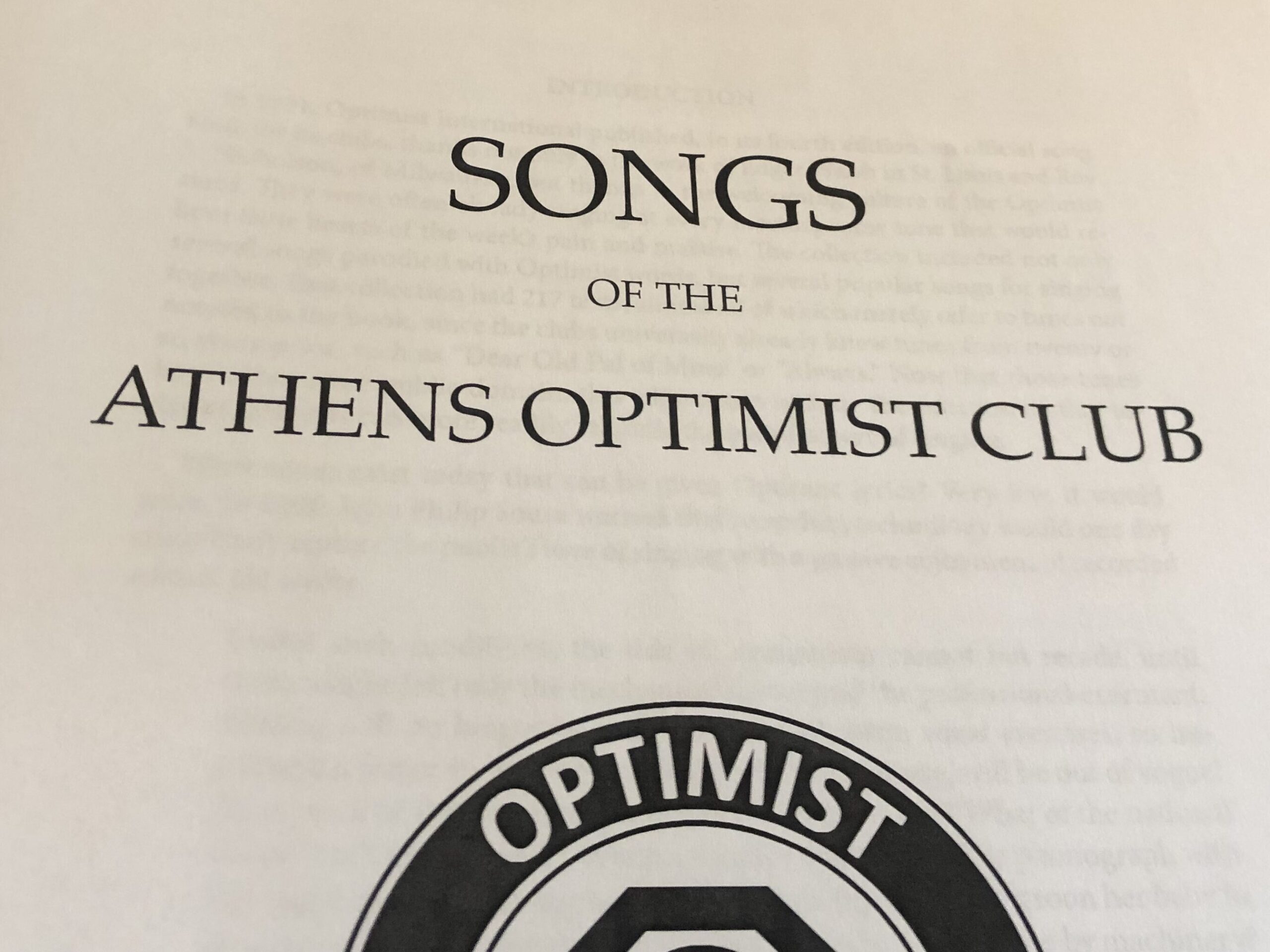
    Over the last year, I’ve been adapting tunes from the 1931 Songs of Optimist International, an extraordinarily rare book, for use in the Optimist Club of Athens, Tennessee. The club had not sung together in a while, so it felt natural to me to lead them in some of the songs of their distant past as an international organization. That effort culminated in the above file, a song book containing several tunes, fully typeset from sources on IMSLP and other public domain repositories, all with the Optimist lyrics from the book, plus a few tunes that may be of interest to Athenian Optimists, like Rocky Top (parodied with my own Optimist lyrics), a song about Tennessee, and a few patriotic and holiday tunes for meetings that approach times where those are appropriate.

    It’s been a pleasure to be a part of this local civic club for the last year or so. They meet at 7 a.m. at the Tennessee Wesleyan dining hall every Thursday morning. You can imagine that shift in mood that happens when people of all walks of Athenian life assemble weekly to do the work of the club and suddenly sing a rousing chorus of some secular song together. As far as I know, this is the only place in town that this happens, especially this regularly.

    I had never heard of this organization; I never noticed the Optimist Club sign in Back to the Future 1 and 2 or ever was around one until coming to Athens. The organization essentially exists as a means of associating for the betterment of the people of the community, especially the youth. Interestingly though, it regularly recites an “Optimist Creed,” which is available on the last page of that song book. It was written by Christian D. Larson, a prominent author of the same New Thought movement that deeply influenced both Christian Science and the Phi Mu Alpha Sinfonia music fraternity—two quite different organizations!

    Evidently, New Thought centered around the notion that thoughts are more real than physical things. So, Larson advocated for mindset change being the primary cause for positive change in one’s life, rather than mere change of circumstance. For the Christian Scientists, it means focusing on the healing power of prayer. For Sinfonians, it is in the mysterious power of music in creating a better society. For Optimists, it’s literally greeting every creature you meet with a smile and being pleased in the successes of others as much as you are about your own.

    People are great. What a joy to contribute a bit of the power of social singing to this community.