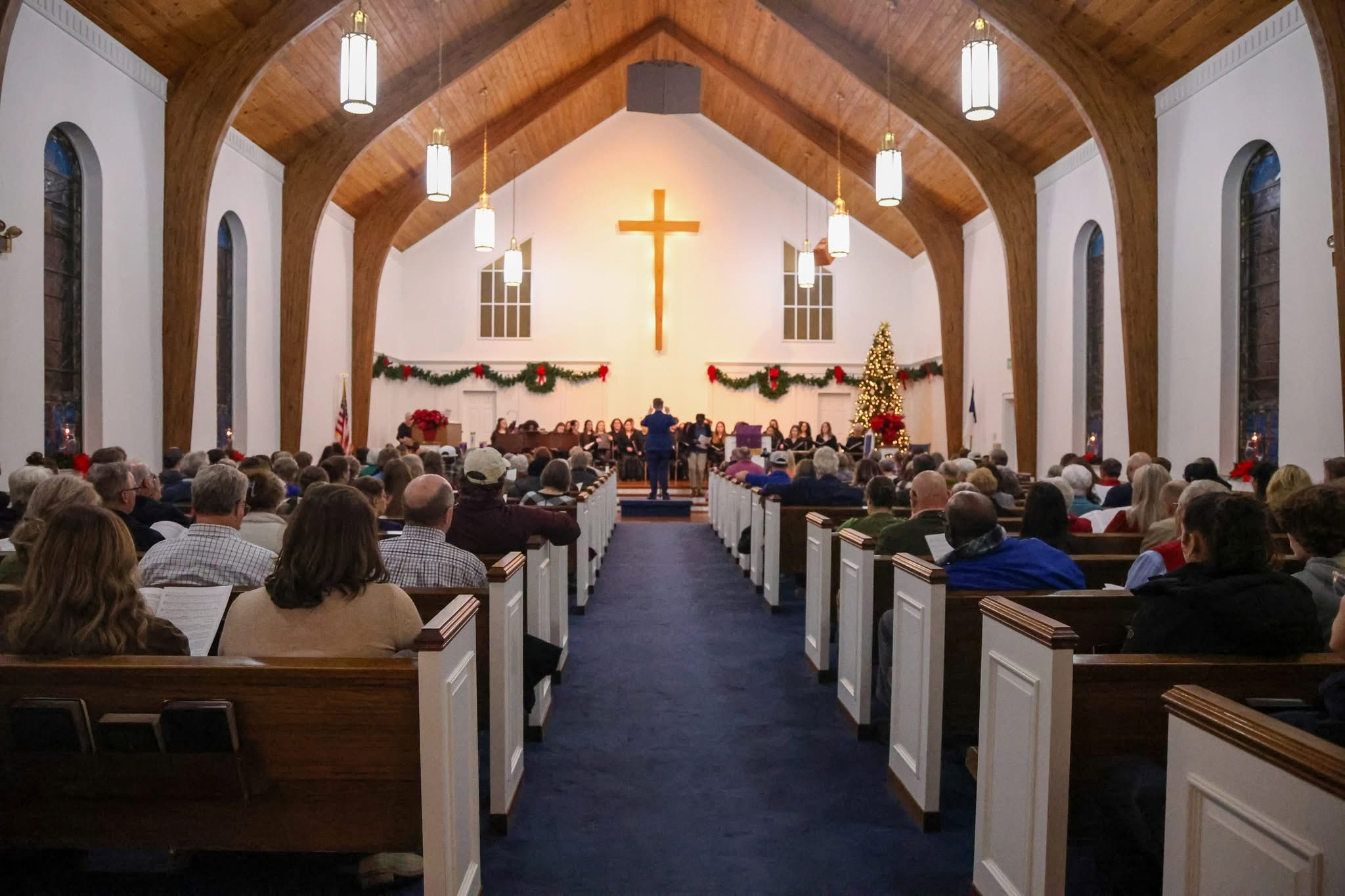
December 2, 2025, was our Lessons and Carols service at Tennessee Wesleyan. This is always an absolute treat to put together—the community rallies behind it, the faculty show great support for it, and the students seem to enjoy tackling some tough pieces and discovering their relations to the texts that they respond to.
There are parts of the service that stay the same each year by design, which helps a sense of ritual for regular attendees. I went with King James language throughout the readings, had professors and administrators (including the university president) read, got to enjoy some great percussion from one of our music minors on djembe, had the congregation sing several hymns (all provided in the program). Several students had never performed for such a large audience or sung this sort of music—and in general, they learned the whole hour-and-a-half concert in a month and change. We had to cut the Willan carol for an emergency absence in the second soprano section.
All in all, it was a successful, human, loving, and fun event, including the famous Josquin motet “Ave Maria … virgo serena” (we went with the Italian Latin pronunciation and a bit of piano help), a bit of Whitacre (“The people that walked in darkness have seen a great light” gets a nice response by “Lux aurumque”), a piece by ElizaBeth Beckham (a dear friend from my undergrad years in the Mississippi Delta), some nice solo opportunities for several singers, and, I am told, several long-lasting smiles from the audience.
I’ve begun teaching Josquin Desprez’s best-known motet, “Ave Maria … virgo serena” to the smaller choir for Lessons and Carols. While making an edition, I started wondering what the historically informed pronunciation of the piece was, especially considering how strangely the text is accentuated in the pitch lengths and contours. Because we so rarely sing Josquin, I hadn’t really investigated what his version of Latin might have sounded like, though I have done similar investigations for all kinds of historical places and times. Sometimes it is helpful to hear Poulenc’s Latin, for instance, as French-accentuated rather than “incorrectly set,” which is what I often hear of his Gloria or Dialogues of the Carmelites.
The above is the edition I made for the choir, which allows four beats per measure and ties off each grouping of notes into those beats of a quarter note in length. I was surprised not to find a particularly easy-to-read edition of this piece with a piano reduction, so I also arranged one of those to speed rehearsal along.
Once that edition was sorted, I began investigating the Latin that this early motet (apparently dated to around 1485) would have been written with in mind.
Harold Copeman’s 1990 out-of-print sourcebook Singing in Latin features some good information on this kind of Latin, which is Franco-Flemish, specifically Picard. This is about as north as Latin naturally traveled in Europe and was heavily influenced by Dutch, as Latin languages go.
Here’s the text:
Ave Maria, gratia plena, Dominus tecum, virgo serena. Ave cujus conceptio, solemni plena gaudio, cœlestia, terrestria, nova replet lætitia. Ave, cujus nativitas, nostra fuit solemnitas, ut lucifer lux oriens, verum solem præveniens. Ave, pia humilitas, sine viro fecunditas, cuius annunciatio, nostra fuit salvatio. Ave, vera virginitas, immaculata castitas, cuius purificatio nostra fuit purgatio. Ave præclara omnibus, angelicis virtutibus, cujus fuit assumptio nostra glorificatio. O Mater Dei, memento mei. Amen.
Using information in that Copeman book, I put this IPA transcription together:
This might be the strangest form of Latin I’ve run into. I haven’t found anyone giving this kind of Latin a go with this piece, but I’m all ears if anyone else has!
This definitely helps me hear why Josquin gently emphasizes the second syllable of “Ave” in the opening, and the other final syllables in the triple section.
Don’t worry; I’ll plan to use Italian Latin with the students. It’s just good to know a bit about his text setting mentality. In all of this, I do want people to think of Josquin not as some abstraction that musicologists secretly discovered at some point, but rather a living, breathing man who lived a long and famous life, becoming the favorite composer of the real living Martin Luther. When we hear his music in his accent, I feel like he comes alive a bit more; it isn’t a museum piece any more, but a real northern French man’s clever putting together of a real text for real people. The Franco-Flemish composers like him and even Dufay, Binchois, Ockeghem, and the rest, formed an influential fad, just like choral music from Latvia and Estonia are becoming more in vogue these days from real people with real choirs.