Author: Andrew

  • Duty in the Ancient and Accepted Scottish Rite

    Duty in the Ancient and Accepted Scottish Rite

    Have you ever sensed a voice within you that knew what things needed doing? What voice within you directed you to pay for a person’s groceries or jump-start a stranger’s car battery? Masonry has a clear answer to this question, and it is surprising. It simply calls this voice “duty.”

    Duty appears to be an inner urging toward virtue. Trying to figure out where it comes from and why it is so pervasive in the human experience is a whole branch of philosophy, known as deontology, from the Greek deon (δέον), meaning essentially “that which is necessary or binding.” Deontological literature exists in abundance, spanning from the eighteenth century to the present day. While the study of deontology is complex, Masonry offers a starting place for the question.

    According to the Rite, Masonry itself is the performance of duty. If this is a higher-level definition that summarizes the definition of Masonry as “a continuous advance … toward the Light,” then duty logically is the pull of the Light. If Light is the Deity’s own nature, then duty is the soul’s directedness toward the Deity. Duty therefore comes directly from the Deity.

    (more…)
  • Reading the Brahms Requiem from Individual Parts

    Reading the Brahms Requiem from Individual Parts

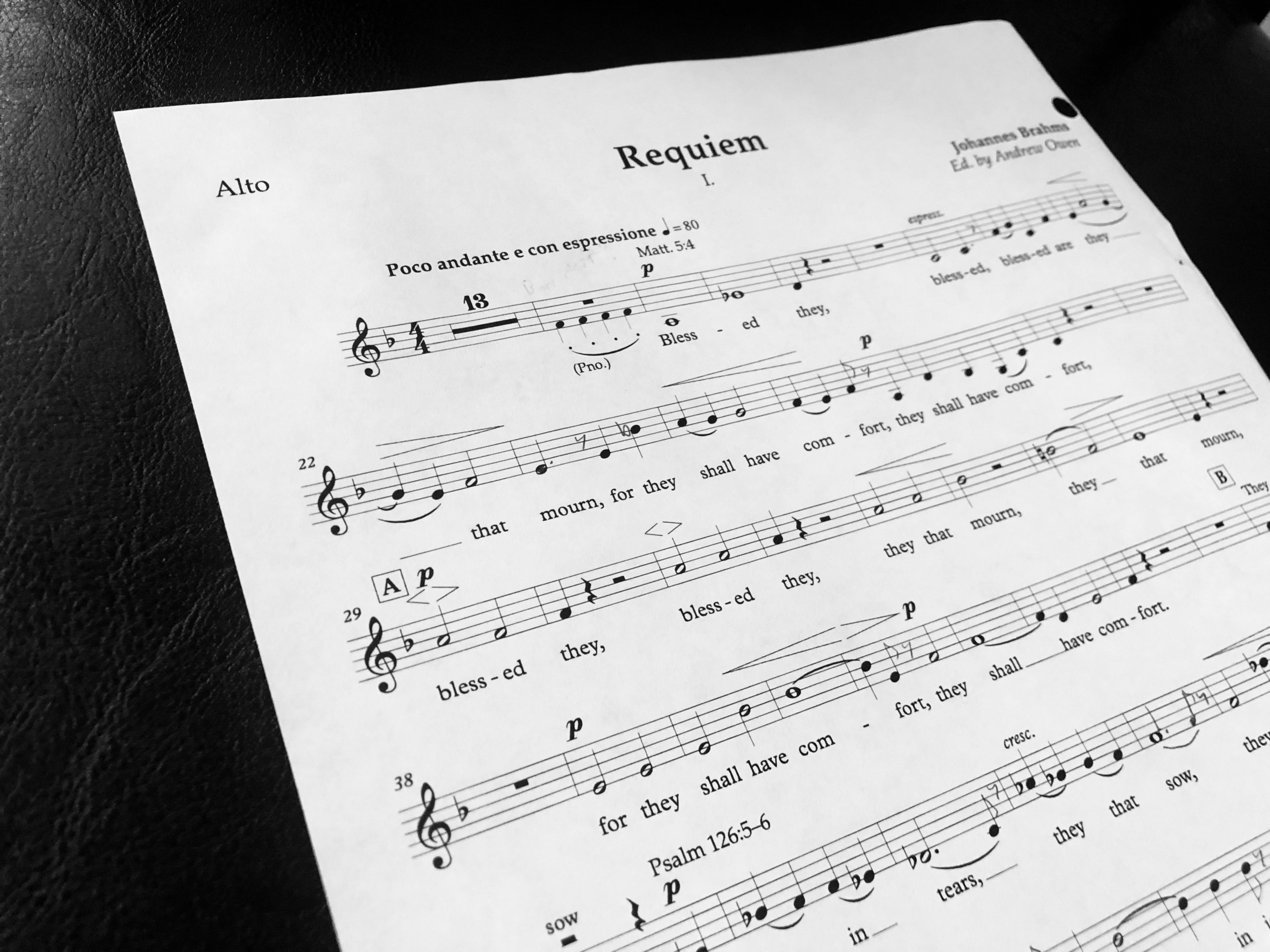
    In the spring term of 2025, I thought it might be possible to teach Brahms’s Requiem entirely from individual vocal parts. Here is what I handed the singers:

    Over the course of the semester, they did a heck of a job with it. For the most part, they had never sung anything longer than ten minutes, so this was the first jump into long-form choral works for most of them. I’ve been reading from parts exclusively since 2012, so I have gotten used to it over the years. It was enjoyable to watch them get accustomed to the practice, which was no doubt the way Brahms’s singers read his music during his lifetime.

    Below is the whole performance of it from the spring concert:

    Feel free to follow along in your preferred part to see if you can count and sing it through!

  • The New Testament in the Shavian Alphabet

    The New Testament in the Shavian Alphabet

    A few years ago, I put together the world’s first New Testament translation fully transliterated into the alphabet that George Bernard Shaw had created for English.

    This was a labor of love. The Shavian alphabet is a fascinating way to write the English language. Once you have become familiar with it, it is like seeing spoken English for the first time. My approach to singing in English vastly changed when I learned Shavian spelling. So much of what we think when we conceive of our language is colored by the Roman spelling that we have become accustomed to over centuries. Instead of 26 clumsy letters having to account for not only the over 40 sounds of English but also show etymology and other conventions, Shavian just lays out what the words sound like in a way that makes sense for English.

    In fact, it can be made even more beautiful through the use of ligatures. Here is the same file with more letters connected:

    I don’t think many alphabets as elegantly display a language as this one. Hopefully you enjoy it if you find yourself curious about this system.

  • A New Song Book for the Optimist Club of Athens, Tennessee

    A New Song Book for the Optimist Club of Athens, Tennessee

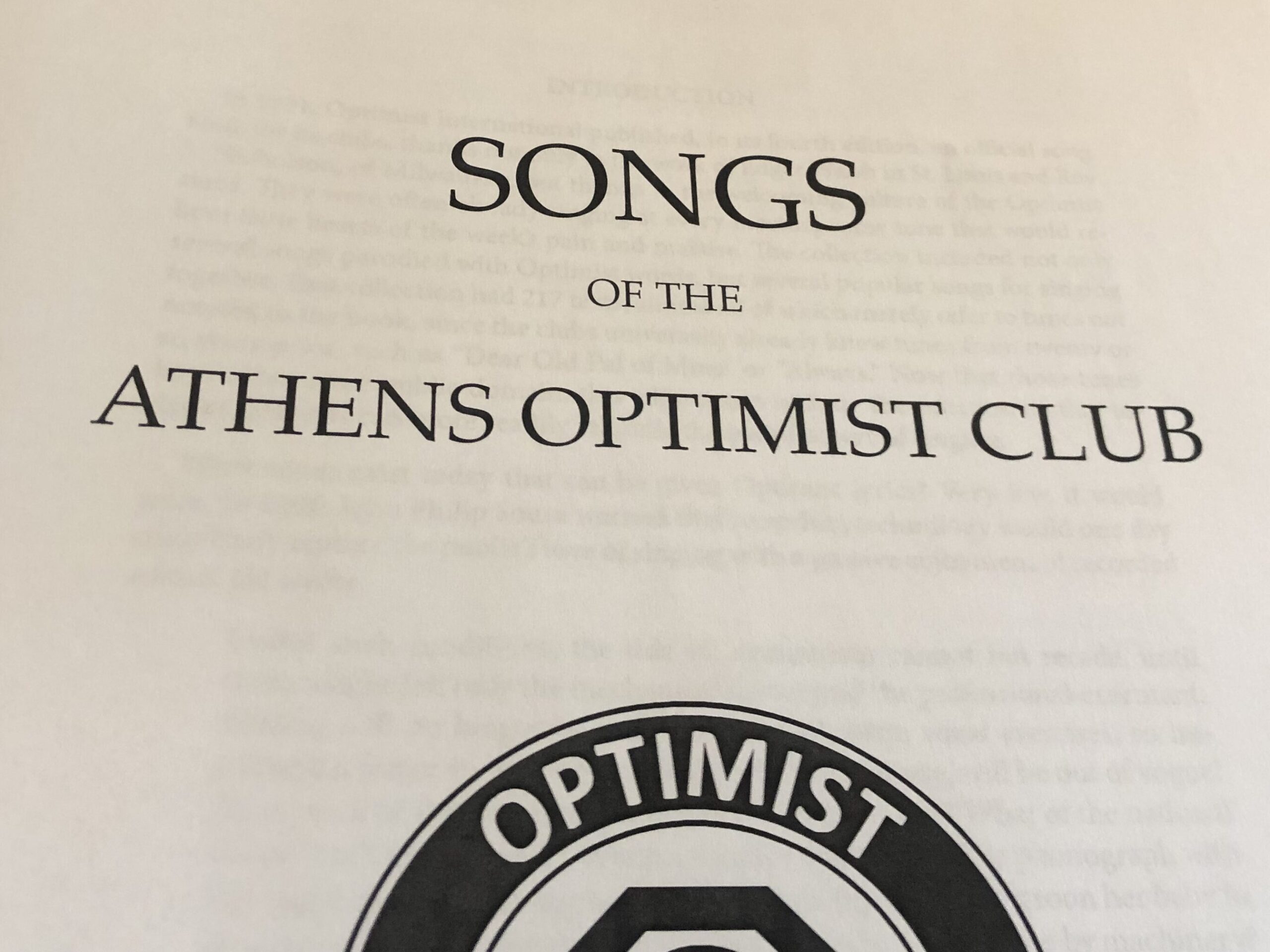
    Over the last year, I’ve been adapting tunes from the 1931 Songs of Optimist International, an extraordinarily rare book, for use in the Optimist Club of Athens, Tennessee. The club had not sung together in a while, so it felt natural to me to lead them in some of the songs of their distant past as an international organization. That effort culminated in the above file, a song book containing several tunes, fully typeset from sources on IMSLP and other public domain repositories, all with the Optimist lyrics from the book, plus a few tunes that may be of interest to Athenian Optimists, like Rocky Top (parodied with my own Optimist lyrics), a song about Tennessee, and a few patriotic and holiday tunes for meetings that approach times where those are appropriate.

    It’s been a pleasure to be a part of this local civic club for the last year or so. They meet at 7 a.m. at the Tennessee Wesleyan dining hall every Thursday morning. You can imagine that shift in mood that happens when people of all walks of Athenian life assemble weekly to do the work of the club and suddenly sing a rousing chorus of some secular song together. As far as I know, this is the only place in town that this happens, especially this regularly.

    I had never heard of this organization; I never noticed the Optimist Club sign in Back to the Future 1 and 2 or ever was around one until coming to Athens. The organization essentially exists as a means of associating for the betterment of the people of the community, especially the youth. Interestingly though, it regularly recites an “Optimist Creed,” which is available on the last page of that song book. It was written by Christian D. Larson, a prominent author of the same New Thought movement that deeply influenced both Christian Science and the Phi Mu Alpha Sinfonia music fraternity—two quite different organizations!

    Evidently, New Thought centered around the notion that thoughts are more real than physical things. So, Larson advocated for mindset change being the primary cause for positive change in one’s life, rather than mere change of circumstance. For the Christian Scientists, it means focusing on the healing power of prayer. For Sinfonians, it is in the mysterious power of music in creating a better society. For Optimists, it’s literally greeting every creature you meet with a smile and being pleased in the successes of others as much as you are about your own.

    People are great. What a joy to contribute a bit of the power of social singing to this community.